
Key takeaways
- Avalanche minimizes total interest, but the gap over snowball is often a few hundred dollars or less across a full payoff.
- Snowball is nearly free when your rate spread is small or your smallest balance is a tiny high-rate debt that clears in one cycle.
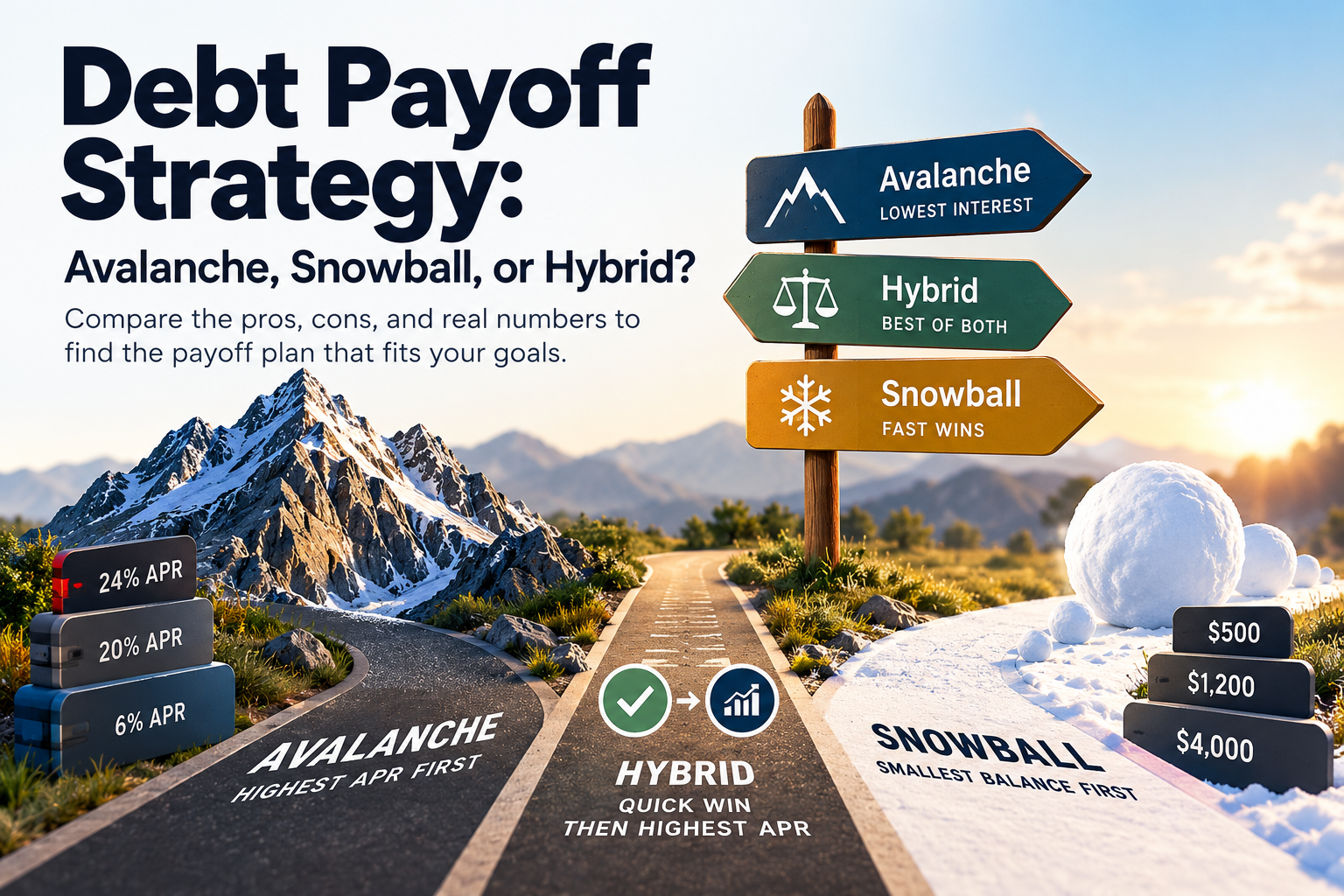
- A hybrid strategy takes one quick win first, then switches to highest-APR-first ordering for the remaining debts.
- Paying off any debt is a re-ranking event: roll the freed minimum into your budget and re-run the decision tree with new numbers.
- If income drops, protect every minimum payment before any extra payoff, then re-rank once the minimums are safe.
Table of contents
What is the difference between the debt avalanche and debt snowball methods?
When does the snowball method actually save you money compared to the avalanche?
How does the same three-debt portfolio play out under each strategy?
What role does motivation play in sticking with a payoff strategy?
How do you recalculate your payoff plan after paying off your first debt?
What should you do if your income or expenses change mid-payoff?
Which tools can run these numbers without another monthly bill?
The right debt payoff strategy depends on three numbers you already have: your rate spread, your balance sizes, and how much willpower each quick win buys you. Pick avalanche if the math gap is big, snowball if you need early momentum, and hybrid when both matter. This guide gives you a decision tree and one worked $9,500 portfolio run through every path so the tradeoffs are numeric, not generic.
What is the difference between the debt avalanche and debt snowball methods?
Both methods keep your total payment amount fixed and roll freed-up money onto the next target once a debt is cleared. The only thing that changes is the ordering rule. Avalanche ranks debts by interest rate, highest first, and mathematically minimizes total interest paid. Snowball ranks them by balance, smallest first, and buys you early quick wins: accounts closed in months, not years. The CFPB's consumer guidance on paying down debt frames the same tradeoff from the borrower's side.
The single variable separating them is your rate spread. If every debt sits within a couple of percentage points of each other, avalanche's advantage shrinks to noise and snowball's momentum may cost you almost nothing. If one debt carries a 24% rate next to a 6% car loan, ordering matters a lot. Whatever you pick, track it in one place, like your Fiscal Station HQ command center, and log your ranking decisions there so recalculation later is arithmetic, not guesswork.
How do you rank your debts before starting a payoff plan?
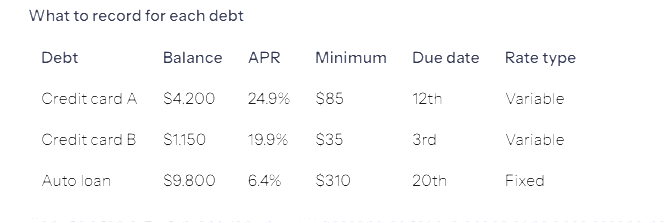
Every debt payoff strategy needs the same five inputs per debt: current balance, APR, minimum payment, due date, and whether the rate is fixed or variable. Pull these from your latest statements or a CSV export, and record them in one place before choosing avalanche, snowball, or a hybrid.
What to record for each debt
Copy this table, fill it in, and rank by APR descending for avalanche or balance ascending for snowball. If a minimum payment is a percentage of balance rather than a dollar figure, convert it using the current statement so your plan stays accurate as balances fall.
Fixed vs. variable rates change the math
Variable-rate debts can move with the prime rate, so a 19.9% card today may be 21% by the time you reach it. Recheck APRs every statement cycle and rerun your plan; a tool like Fiscal Station HQ keeps balances, rates, and due dates in one command center so recalculating takes minutes, and the guide walks through reconciliation after each update.
When does the snowball method actually save you money compared to the avalanche?
Avalanche always wins on total interest in pure math terms, but the gap is often a few dollars, not hundreds. Two cases make snowball nearly free. First, a small rate spread: a 7% car loan versus an 8% card means ordering barely moves the needle, because interest owed each month is roughly balance × rate ÷ 12 (the standard amortization formula Investor.gov explains). Second, a tiny high-rate balance: if a $180 card at 24% clears in your first paycheck cycle, it stops accruing immediately either way.
Run your own numbers before committing: total interest under each ordering, then ask whether the difference justifies fighting your motivation style. If it's under $50 across a full payoff, snowball's early wins cost you almost nothing.
How does the same three-debt portfolio play out under each strategy?
Assumptions and the payoff budget
Take a three-debt portfolio: a $2,000 credit card at 24.99% APR, a $6,500 credit card at 19.99% APR, and a $12,000 car loan at 6.50% APR. You commit a fixed $600/month to debt payoff until every balance hits zero. All figures below are illustrative, rounded, and assume minimums are covered inside the $600 with the remainder rolled forward as each debt dies.
Avalanche results
Highest rate first: the 24.99% card dies around month 4, the 19.99% card around month 13, and the car loan around month 33. Total interest lands near $2,050. This is the cheapest path on paper, and the gap only widens if rates rise.
Snowball results
Smallest balance first: the $2,000 card clears around month 3, the $6,500 card around month 14, and the car loan around month 34. Total interest runs near $2,240. That is roughly $190 more than avalanche, the price of one fast, morale-lifting win in month three.
Hybrid results
Kill the smallest balance for the psychological win, then switch to rate order: the $2,000 card clears month 3, then the 19.99% card, then the car, finishing around month 33 with interest near $2,100. The honest takeaway from running one portfolio three ways: the spread between strategies is a few hundred dollars over nearly three years, so the plan you will actually follow beats the plan that saves $150. Run your own numbers locally in a tool like Fiscal Station HQ, where your balances stay on your machine per its privacy policy, and re-run them whenever a balance hits zero.
What role does motivation play in sticking with a payoff strategy?
Motivation is a legitimate input, not a soft one. A plan you abandon in month four costs more than a mathematically worse plan you run to zero. The honest test: look at your last three months of behavior. If you've ever paid extra on a debt and felt no visible progress, you're likely a quick-win seeker, and snowball's small balances will keep you paying. If you've happily chipped away at a 401k match or a mortgage with no feedback loop, you're a math optimizer, and avalanche fits.
The failure mode is lying to yourself. Pick avalanche because it's "correct," then stall when the 6% car loan barely moves while a $400 store card sits there untouched. Run the three-debt portfolio in the section above and check your gut reaction: if the avalanche timeline feels discouraging, that's data.
Whichever you pick, track it somewhere you control. A local plan you can open, edit, and reconcile without an internet connection, like the one in Fiscal Station HQ, keeps your payoff numbers and your data on your own machine (https://fiscalstationhq.com/security).
How do you build a hybrid debt payoff strategy?
A hybrid takes the avalanche's math and the snowball's psychology and applies each where it earns its place. Three patterns cover most situations.
Pattern 1: one quick win, then avalanche
Knock out your smallest balance first, regardless of rate, then switch to highest-APR-first for everything else. One closed account in month one or two gives you a concrete proof point, and the interest cost of the detour is usually tens of dollars if the balance is small. After that, every dollar goes where it compounds fastest.
Pattern 2: rate-threshold split
Set a cutoff, say 15%. Above it, avalanche; below it, snowball. The cutoff matters because average card rates have run well above that line for years; the Federal Reserve's G.19 release tracks where they sit (https://www.federalreserve.gov/releases/g19/). A 24% card and a 6% car loan behave differently enough to justify different rules.
How do you recalculate your payoff plan after paying off your first debt?
Paying off a debt is not the finish line; it is a re-ranking event. Run the same three-step routine each time: roll the freed minimum into your payoff budget, re-rank the remaining debts by rate and balance, and re-run the decision tree with your new numbers.
Using the illustrative three-debt portfolio from earlier, say the snowball order cleared the smallest balance first and freed a $75 minimum. That $75 now stacks onto the next target's payment, cutting its payoff time roughly in half depending on the balance. Re-rank before you assume the original order still holds: if the next-smallest debt carries a much higher rate than the largest one, the hybrid math may now favor switching targets.
Recalculate monthly at reconciliation time, not just when a balance hits zero. Rates on variable debt drift, and a bonus or a slow month changes the optimal order. A desktop tool with CSV import lets you re-run the numbers locally whenever you want, without waiting on a server.
What should you do if your income or expenses change mid-payoff?
Protect the minimums first. If income drops, cut every extra payment before you miss a single minimum — a late mark costs more than any ranking decision does. Once minimums are safe, re-run your ranking: balances have shrunk, and variable-rate cards reprice with the market, so the highest-APR target may have changed since you started (Consumer Financial Protection Bureau).
If income rises, don't reorder — just enlarge the payment on your current top target. Re-ordering mid-run resets your momentum for pennies of gain. Pause extra payments entirely only when you have no emergency buffer left; rebuild one month of expenses, then resume the same order you were already following.
Which tools can run these numbers without another monthly bill?
What the math actually requires
Every strategy in this article needs three things: a way to order debts by rate and balance, a what-if recalculation when a debt closes or your income shifts, and data you control. A free spreadsheet meets all three. The tradeoff is manual work: you maintain the formulas and re-sort the order yourself after every payoff.
How the desktop options compare
Actual Budget handles envelope planning and payoff tracking locally, but its what-if modeling stays basic. Quicken and Moneydance both include loan calculators and debt reduction planners, with Quicken the priciest of the desktop set. Money Manager EX is free and local-first but leaves the ordering math to you.
Fiscal Station HQ runs avalanche, snowball, and hybrid orderings on your own CSV-imported data, recalculates after each payoff, and keeps everything on your desktop. Where it falls short: no automatic transaction import, so high-volume enterers face the manual-entry burden they've criticized elsewhere, and its what-if scenarios assume steady extra payments rather than irregular windfalls.
FAQ
Is it better to pay off high interest or high balance first?
High interest first, in almost every case. Interest owed each month is roughly balance × rate ÷ 12, so a 24% card costs far more per dollar than a 6% car loan regardless of balance. The exception is psychology: if a small balance gives you a quick win that keeps you paying, the interest gap may be a few dollars, not hundreds.
How much interest can the avalanche method save over the snowball?
Often less than you'd expect. In the worked three-debt portfolio ($20,500 total at 24.99%, 19.99%, and 6.50%), avalanche cost about $2,050 in interest versus roughly $2,240 for snowball, a gap near $190 over nearly three years. When rate spreads are small, the difference shrinks to noise. Run your own numbers before assuming avalanche justifies fighting your motivation style.
Should I pay off my car loan or credit card first?
Almost always the credit card. Card rates commonly run well above car loan rates, so the card accrues interest faster on every dollar. A 24% card next to a 6.5% car loan is not a close call. One caveat: if a variable-rate card reprices or your car loan carries an unusually high fixed rate, recheck the APRs before committing to an order.
Can I switch from snowball to avalanche halfway through?
Yes, and paying off a debt is the natural moment to do it. Clearing a balance frees its minimum payment and is a re-ranking event: roll the freed money into your budget, re-rank the remaining debts by rate and balance, and re-run the decision tree. Just recalculate before switching so you know the interest cost of the detour you already took.
Do minimum payments go down as I pay off debts?
Sometimes. Card minimums are often a percentage of balance, so they shrink as the balance falls; if yours is a dollar figure, it usually stays fixed. Fixed-rate installment loans like car loans keep the same payment until payoff. Convert percentage minimums to dollar figures each statement cycle so your payoff plan stays accurate as balances drop.
Explore the Fiscal Station HQ user guide for product instructions.